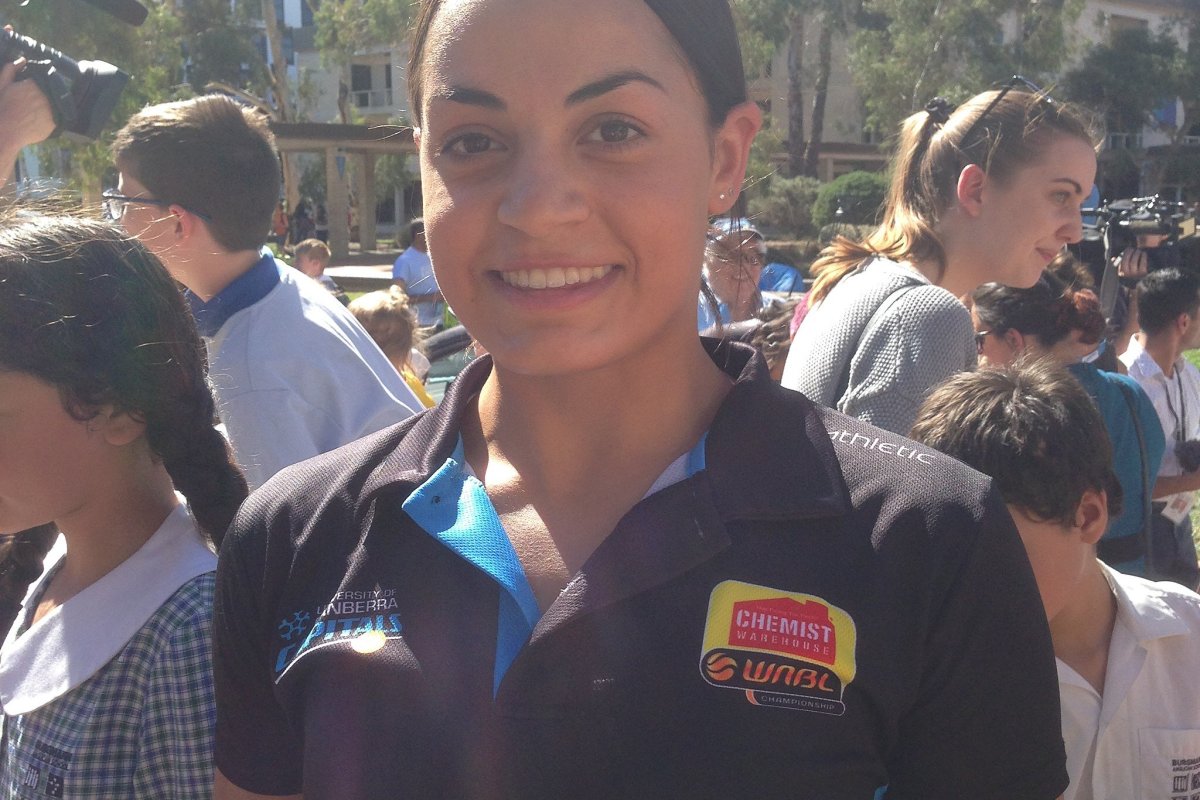
Maddy Rocci was one of the league’s big improvers in season 2019/20, emerging as a committed, high energy perimeter defender and a resourceful passer.
Having played just under six minutes in game three of the 2019 grand final, the 22-year-old guard earned 37 minutes in this year’s decider.
She recently re-signed with the University of Canberra Capitals for a tilt at a rare three-peat.
Along with Rocci, Marianna Tolo, Kelsey Griffin, Keely Froling, Alex Delaney and Abby Cubillo have all committed to another year. It makes for a level of continuity that Rocci believes will give the group a running start.
“It’s always good to try and keep a core group together,” she tells The Evening Game. “It’s hard playing with players you haven’t played with before and it takes you a while to get rolling.
“Having the six of us return is super exciting. We know how each other plays, how we train and we know how to work hard.
Rocci is currently based in Brisbane, having moved north expecting to work at a local school and play in the WNBL1 over winter. With that competition scrapped, she has been doing individual training with a coach and has recently been allowed back into basketball courts.
Having watched former teammate Olivia Epoupa diligently arrive before training to fine-tune her ball-handling, Rocci is now focusing on this skill, along with three-point shooting. Her long-range percentage has already improved steadily; she made only one of 12 three-pointers in her rookie year, jumped to 32.6% in year two and put up 36.1% last year while taking twice as many shots from the previous season.
Further honing these guard skills will serve her well in a campaign where there will be no imports and the Capitals will be adjusting to life without Epoupa and reigning MVP Kia Nurse. Both were high-usage players and focal points of the team’s attack; they took a combined 69 shots over the two grand final games. Their absence will likely mean Rocci is tasked with more a scoring responsibility.
It’s a challenge she is up for. “You can’t replace such great talent,” she says of the pair. “But I’m looking to step up, take on a bigger role season and really develop my game”.
One other player looking to fill that void will be new signing Tahlia Tupaea, a close friend of Rocci’s.
Rocci believes she will alternate between the one and two alongside the similarly versatile Tupaea, a former teammate in Australian youth teams. “Gorrie (coach Paul Gorris) said I’d play a bit more of the one (next season), which is super exciting because I’ve always been a point guard until recently.
“To be able to play (both guard positions) is something I’ve always wanted. I don’t want to be a player who can only play one position.”
When Adelaide Crows co-captain Erin Phillips lifted the AFLW champion’s trophy aloft in front of more than 50,000 fans, the Australian women’s basketball fraternity could have been forgiven for viewing the moment with a bittersweet pang. The triumph was the apex of a remarkable cross-code transition by one of the best Australian basketballers of her generation, but the headlines and record-breaking crowds would have been foreign to many involved in Phillips’ old WNBL stomping ground.
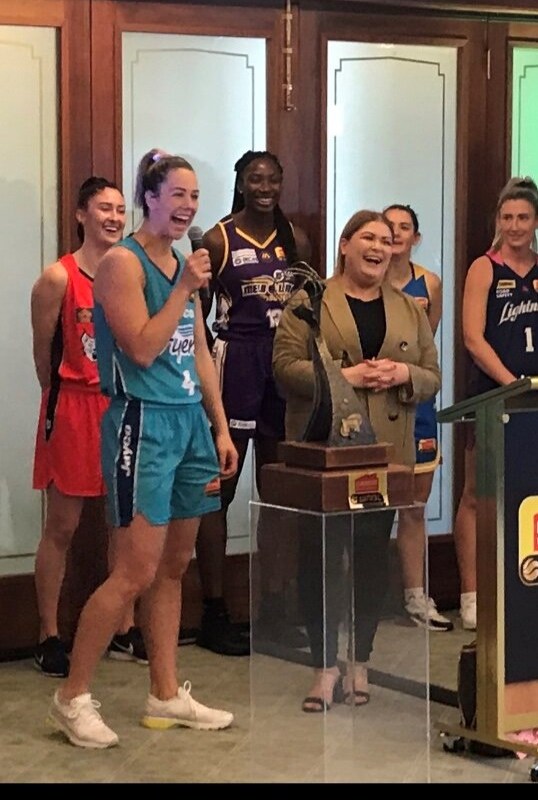
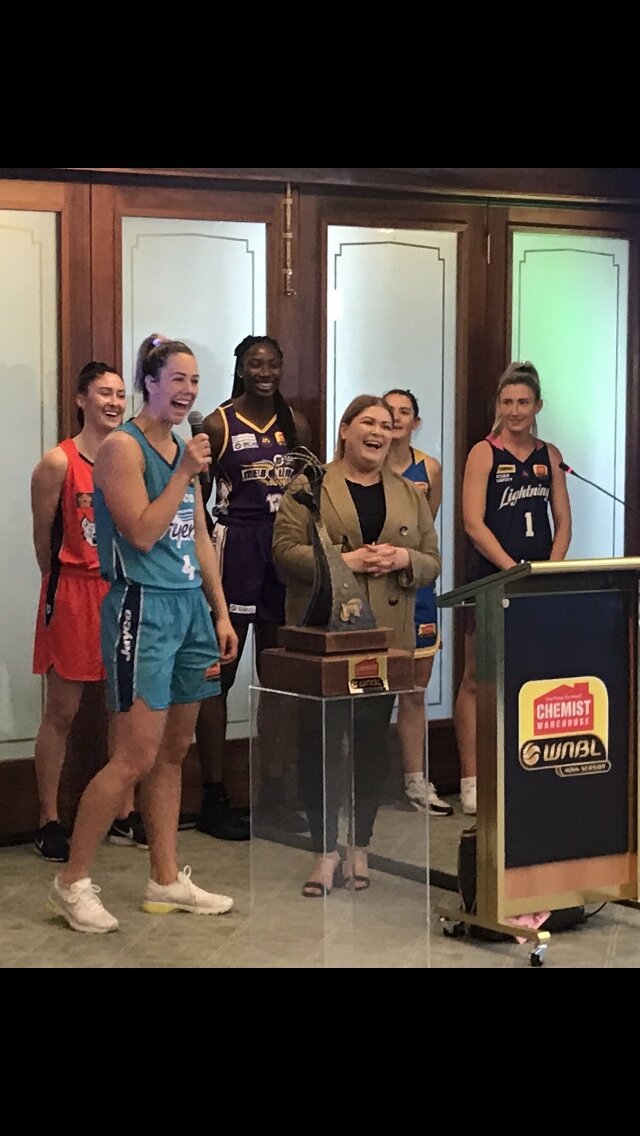
In the genteel surrounds of Old Parliament House, the WNBL launched its 40th season. The Evening Game was there to soak up the occasion and quiz some of the competition’s key players on the upcoming campaign.
Defending champions start as favourites
With Kia Nurse, Marianna Tolo and reigning MVP Kelsey Griffin all back on board, the University of Canberra Capitals’ squad retains plenty of its championship lustre heading into #WNBL20.
By the time last year’s finals rolled around, the Capitals were less a team with momentum than a basketballing avalanche, but there was still a genuinely challenging moment for them after losing game two of the finals. The match saw them endure one of the most dramatic and heartbreaking defeats in a WNBL decider. Coach Paul Goriss gives an insight into how they picked themselves up after it.
“It wasn’t so much the physical fatigue, it was more mental fatigue,” he explains. “I won’t hide the fact that it took us a full day to get over the hurt and pain of that loss. But I think that’s what drove us in game three. We wanted to make amends.”
Nicole Seekamp’s last-second game-winner forced the first finals game three in WNBL history, but the setback had a silver lining for Gorris’ team. “It gave us the opportunity to come back home and win it in front of our home crowd, which was really important to us.”
Goriss believes every WNBL team have improved their squad since last year but that his team is well-equipped despite losing two of the league’s all-time great point guards in Leilani Mitchell and Kelly Wilson. “There’s not a replacement for those two, but it’s about getting the next best player we can,” he says.
“Their experience and knowledge of the league is a huge loss but we’ve got Olivia Epoupa coming in and she’s played in big games in Europe and for France in the Olympics and World Championships.”
Point guard ✅ Welcome Olivia Epoupa, French National Player, to the UC Caps for #WNBL20!
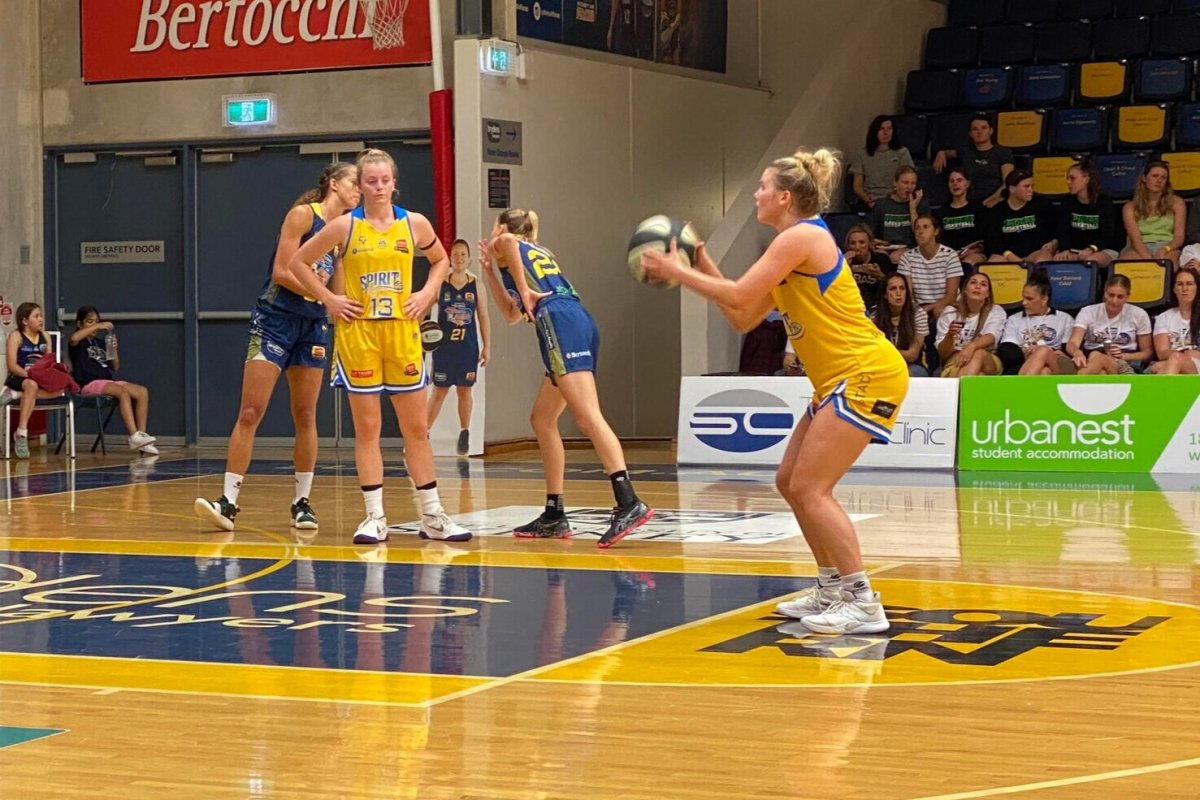
Diminuitive point guard Tessa Lavey inspired baffled laughter through the grand Old Parliament House members’ room when she revealed the Spirit had been playing “the murder game” on a recent pre-season road trip.
“It’s really fun,” she told The Evening Game, outlining the rules, which see players draw either a V (for victim) or an M (for murderer) out of a hat and then plot to figure out the assigned killer.
On-court, the Spirit promise to be just as fun, if a little less murder-y. The whippet-like Lavey is made for up-tempo basketball and says she opted for a return to Bendigo partly for the run and gun offence new coach Tracy York plans to implement.
“We’re going to try to lead from our defence, make sure we get in the lanes, make teams do something different and then just run,” Lavey says. Expect full-court presses and fast-break points galore.
Small-ball line-ups are also likely to be part of the M.O, with Lavey likening their new offence to the multiple-guard groups York oversaw as assistant coach of the Adelaide 36ers.
She anticipates playing long minutes alongside Kelly Wilson. “I think we’ll play a lot of swing one-two, where whoever gets the ball runs the play and vice versa.” It looms as an, ahem, killer backcourt pairing.
Lauren Scherf has switched from the Capitals to the University of Sydney Flames, a transfer that should instantly improve the latter’s rebounding and second chance points tallies. These were two areas where they struggled mightily last season after the injury-enforced absence of Alex Bunton.
The Flames have a new coach (Katrina Hibbert) and a new look without retired leader Belinda Snell, but Scherf says they still have some of the DNA of the side that romped emphatically to a championship in 2016/17.
“There’s still a few girls there and they’re very hard-working and passionate, so it’s a good environment. ‘Froggy’ (Hibbert) brings a lot of energy and a good atmosphere to the team, so I think if we have a good spirit, we can really do well.”
Standing at 196cm (6”4), Scherf could be pigeonholed as an interior player, but she’s seen the recent trend towards more and more three-pointers reshape the game and doesn’t mind it one bit.
“I do love to shoot a three myself,” she laughs. “(Bigs) being able to spread the floor, it’s changing the game. It’s making this league and the international game ten times better.”
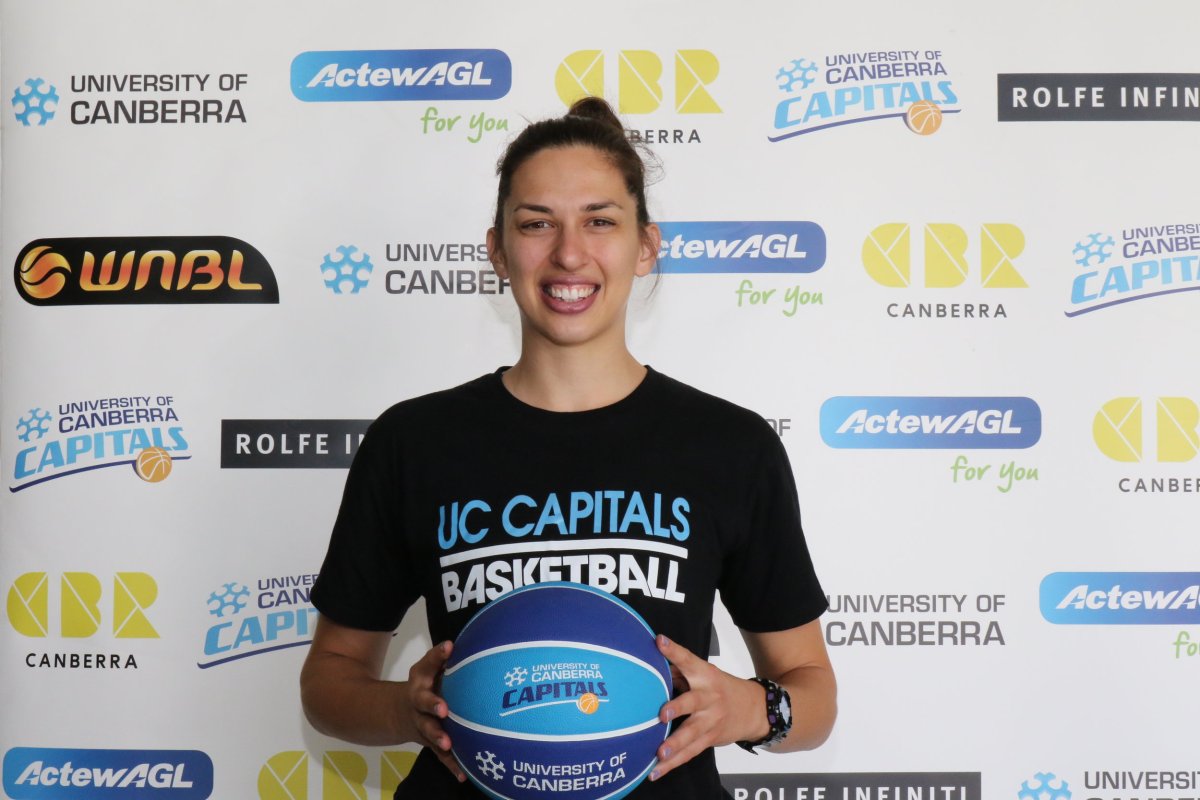
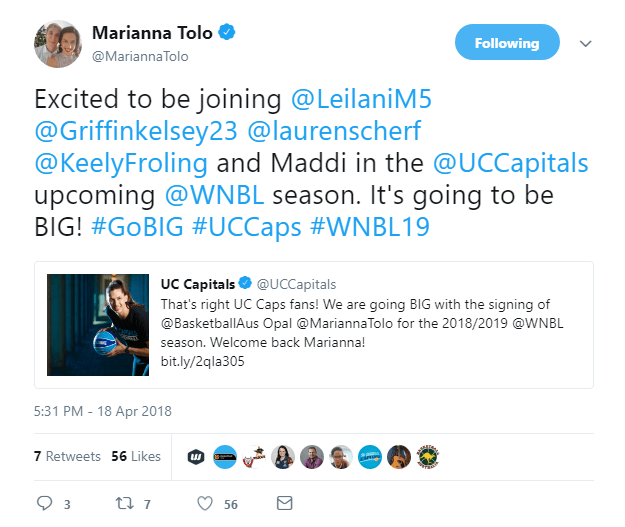
With all-star five calibre stars in Leilani Mitchell and Kelsey Griffin already locked in, the University of Canberra Capitals have made an aggressive change of direction in the off-season. Their latest signing is one of the city’s favourite daughters, Marianna Tolo, returning after a year in Turkey.
Her stint with Abdullah Gül Üniversitesi was cut short by a ruptured anterior cruciate ligament, but Tolo says it is good to be back anyway.
“It’s definitely nice to be home. You get to enjoy the little things you miss when you’re overseas.”
With the injury having occurred almost two months ago, Tolo has already progressed back into light track work and jumping and hopes to be running again in a month.
Tolo reunites with coach Paul Goriss. “I’m happy to play for him again,” she says. “He’ll do everything to put the best team forward.” Photo: University of Canberra.
Having previously suffered the same injury in 2015, she says the recovery process is slightly smoother this time.
“I feel like I’ve got a better range of movement and I’m stronger.
“I’m also not as fearful because I’ve been through it before. I know what I can and can’t push, I know what to expect.”
A ruptured ACL brings with it one of the most gruelling rehabilitation processes of any sports injury, but Tolo is upbeat and enjoying the familiar environment and high-level rehabilitation facilities available in Canberra.
“I would prefer to (rehab) at the AIS over anywhere else in the world.
“I think we have the best facilities and the best staff and everything you need to help you through that process. I’m really grateful that I have the opportunity to do that.”
The University of Canberra Capitals have several more roster sports to fill, but there is already the core of a title contender in place and the tantalising possibility of a Mitchell/Tolo pick and roll being a staple of their offence.
The addition of Kelsey Griffin alongside Tolo in the frontcourt should also significantly bolster the team’s rebounding and ability to get second chance points, where they ranked only seventh and sixth respectively last year.
Tolo’s return also instantly improves the group’s ability to protect the rim. One of the WNBL’s elite shot blockers, she also holds the league record with a ludicrous 13 blocks in a single game.
Her impact off the court, however, may be as valuable her two-way contributions on it; in a previous interview with this site coach Paul Goriss described her as “irreplaceable” and “just amazing with the playing group.”
Her presence at training will likely be particularly beneficial for young bigs Lauren Scherf and Keely Froling, both aged 22 and already double-double beasts at SEABL level.
Tolo says she is more than happy to play mentor. “I’m a bit older now, and with that comes a bit of responsibility to try to help as many people as you can.
“I’ll be looking to help them get the most out of their experience and get a little bit better every day. I will try to push them at training and I’m sure they will push me as well.”
Admitting to some pangs of jealousy while keeping an eye on the WNBL from Europe last season, Tolo says the league is on an upwards trajectory with its return to television.
“I feel like more people were engaged and definitely more people were talking about it.
“I’m glad that we’re making progress and I look forward to more changes we can make and ways we can step forward even further.”
Her return may to the court may not be until late in the year, but Tolo is already looking past that and eyeing a return to the post-season for the UC Capitals.
“Hopefully, we’ll get back on track during this season and bring a championship back to Canberra.
“I would love to have that experience again, it’s been a long time.”
Of all sport’s clichés, perhaps the most insidious is that nice guys finish last. Over her decorated WNBL career, Carly Wilson was like a one-woman counterargument to that idea, being one of the league’s most successful competitors as well as a universally popular figure and admired teammate.
Speaking to this site shortly after the last of her 363 games, UC Capitals head coach Paul Goriss said the club was keen to keep such an affable and experienced figure around, an ambition now realised with Wilson coming on board as an assistant coach.
“It feels like a natural progression” Wilson says of the appointment. “I’d taken on some player coaching roles in my last few seasons and I’ve always been lucky enough to have a really good relationship with the head coach as a player where I would be able to speak to them about anything I could see that I thought could help us, or they would come to me and get my opinions on things.So, I always thought (coaching) was something I would go into at some stage.”
Wilson is already relishing the move. “Every time I get to training and I’ve rushed from work and it’s been a ‘not great’ day because things have been super stressful, I think ‘Yes, I’m glad I’m on this side of the fence and not doing that same warm-up I’ve done a million times before!’. It feels right”
While Wilson played with the team last season, the squad is quite different, with only Kate Gaze, Abby Wehrung and Keely Froling returning from last year’s fifth-placed group. The youthful trio all saw Wilson as something of a mentor or quasi coach already, something she says may make the transition from playing group to coaching staff smoother.
Work commitments will likely prevent Wilson from doing too many individuals or video work, but she will be hands on at training and helping out with game plans. Wilson and fellow assistant, Peta Sinclair, a WNBL champion and experienced coach, are still working out the details of how they will divide up tasks. “I think that will happen organically during pre-season” Wilson says. “We’ll see which areas we feel comfortable in, and where we have ideas that we think will work.”
A physically taxing season ahead
One area Wilson feels her recent experience as a player can help with is in monitoring fatigue, training load and minor injuries. “When someone turns into a head coach, it’s difficult for them to keep track of those things, they just need players on court for longer and want to be coaching for as long as they can.
“I’ve still got that player mentality. If ‘Gorrie’ says at the start of training ‘We’re going for an hour and a half today’, then I’m in his ear when 90 minutes is up saying: ‘Right, how long more are we going for?’
Having a feel for the nagging pains and niggling injuries will be doubly important in the newly condensed WNBL18 schedule. “It will be a really big learning curve…it’s an environment we haven’t had to deal with before.” Wilson says. “This year there’s lots of double headers, lots of games in a short time, a lot of travel. We need to make sure we have those fit, happy, healthy bodies.”
Making the challenge even greater is what shapes as a hard-fought, supremely even competition. “I think it’s going to be really tight across the board, as you say each team could make a case for winning the whole thing.” Wilson needs to look no further than last year’s team to know the margin for error can be razor-thin in the WNBL, even for a richly talented squad.
“When I think of the team we had last year, we had such a great team and we really should have won more games. You just drop a couple and all of a sudden, you don’t make finals.”
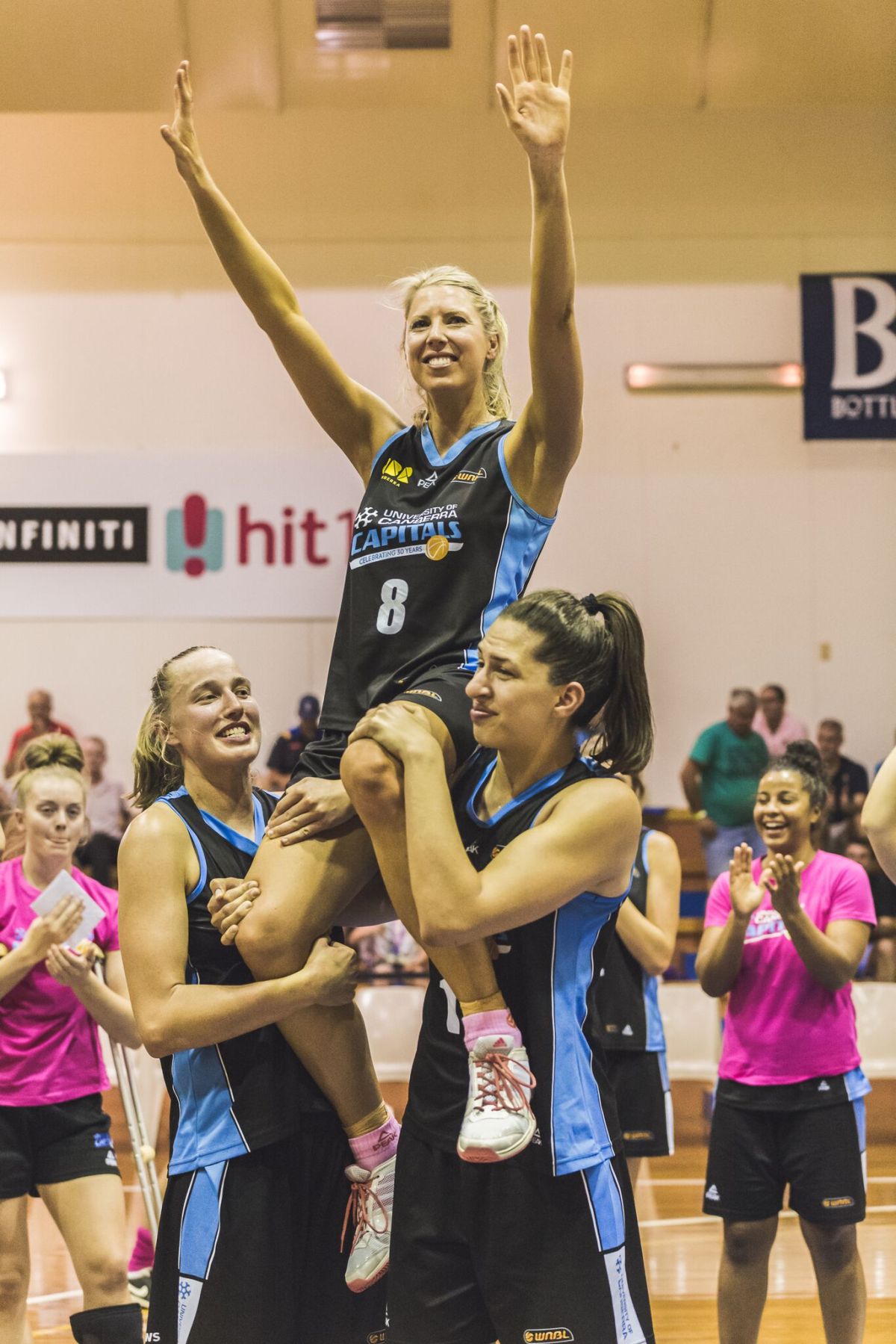
The retiring Wilson chaired off court by Mikaela Ruef and Marianna Tolo. Photo: 5 Foot Photography
Veteran leadership
A number of experienced players from last year, including floor general Lauren Mansfield and imports Mikaela Ruef and Jazmon Gwathmey have moved elsewhere. Most significantly, the team’s co-captain, offensive focus and general good egg, Marianna Tolo, has returned to European competition.
In light of this turnover, Wilson says the locker room presence of Mistie Bass and seven-time WNBL champion Nat Hurst becomes even more important. “You’ve always got to have those steadying veterans, that people can look to on court to calm everyone down, call the plays, make good decisions. We’re lucky that we’ve got two really good ones.” Wilson also sees Rachel Jarry as a leader amongst the playing group, a role the dual Olympian has been eager to embrace.
The veteran know-how should help bring the squad together quickly. “It’ll be really important to make sure everyone’s bonded and on the same page” Wilson reflects. “In other seasons, having a slow start might not affect you that drastically, you have to time to pull it back together. But now, if we’re talking the first three weeks, that’s already six games and a huge chunk of the season done. You don’t have that luxury of easing your way into it.”
It should make for a challenging, fascinating season and the league’s return to television only adds to the excitement. “It’s even bigger than people probably realise” Wilson says of the broadcast deal. “It couldn’t be more important and I’m thrilled about it.”
With Opals star Marianna Tolo returning to Europe and champion Carly Wilson retiring, the Capitals needed a genuine star signing to build on their progress this season. They now have that, with two-time Olympian Rachel Jarry agreeing to join the team for next season. It’s a major boost not just for the Canberra team, but for a league competing with lucrative overseas leagues for the best Australian talent.
“It is really exciting” Jarry said of her return. “I love playing in the WNBL. The opportunity to play with the Capitals has worked out really well”.
Briefly back in Australia after a season with French club Lattes Montepelier, Jarry says she kept an eye on the Australian competition from Europe and liked what she saw from her new team. “I thought the (Capitals) brought in some really young girls who showed a lot of improvement, so it’ll definitely be exciting seeing where they’ll go next season”.
““It is really exciting” Jarry says of her return. “I love playing in the WNBL”.”
While still only 25, already has a wealth of high-level experience, with the London and Rio Olympic campaigns, a WNBA championship run with the Minnesota Lynx and a spell with Lattes Montepelier, which included a Supercup win and Euroleague competition. It’s experience that Jarry hopes will translate into a leadership role at the Capitals, where she can mentor young stars like forward Keely Froling.
“I think that’s a strength of mine, that something that just comes naturally to me” she says of being a leader. “If I can help (the young players) out in any way, it’s only going to benefit the team”.
In her last WNBL season, Jarry was a top 20 scorer and rebounder and hit three-pointers at a scorching 47%, good for third best in the league. She gives Canberra a genuine two-way force on the wing.
Rachel Jarry with coach Paul Gorriss. “I’ve known ‘Gorrie’ for a long time” she said.
“I think I’ll probably be in that 3 (small forward) spot, maybe moving around positions when needed. I think playing at the 3 gives me that flexibility to play as a guard or if I get a smaller matchup, I can post up as well. It gives me a chance to show my versatility”.
Having seen a range of defensive assignments during her time in France, Jarry will give the Capitals a player capable of defending multiple positions. “I was matching up with some of the great bigs in the world and also guards” she says. “I think that’s another strength of mine, being able to defend different matchups”.
Speaking just before the league’s new TV deal was announced, Jarry feels the league is in a better place now than during her last season here, when she was signed to the now defunct South East Queensland Stars. “The league is always strong, but it’s about being sustainable and making it attractive for Opals to stay here. Hopefully there are exciting things on the horizon…which I think will help attract girls back here”.
Having played in the sport’s top league, the WNBA, Jarry says the experience has improved her attention to detail. “You need to be really on top of your one-percenters” she says of the demands of the WNBA. “Getting enough sleep, eating the right things, everything like that”.
Already an elite WNBL player before joining Minnesota, Jarry has continued to fine-tune her game. “I’ve improved my decision-making and that is something that’s constantly a focus of mine” she says. “I think overall my basketball smarts have improved a lot”
Set to rejoin Canberra after a WNBA season with the Atlanta Dream, Jarry is hopeful there are better days ahead for the league. “We’re doing some good work behind the scenes, hopefully that will come into public knowledge soon and we’ll be able to showcase our sport and make it attractive for young girls to get involved”.
With seven premierships to their name, the University of Canberra Capitals are the most successful club in WNBL history, but after losing the iconic likes of Lauren Jackson, Jess Bibby and coach Carrie Graf to retirement, had endured two barren years. Under new coach Paul Goriss, who joined the team from Basketball Australia’s Centre of Excellence, their primary aim was to restore a winning culture to the club and identify young players who can form the core of the team for years to come.
Coaching staff identified 14 wins as the magic number to qualify for the semis before the season, but felt the finals would just be the “icing on the cake”. After only recording two wins last year, the Capitals tallied 13, with a couple of heartbreaking losses and badly-timed injuries seeing them just miss the playoffs. They beat every other WNBL team, but also lost to every other opponent. Overall, their improvement was dramatic, with the team increasing their points per game from 60.8 last year to a far healthier 72.
One of many blocks by Marianna Tolo.
A huge part of this resurgence was down to the return of Marianna Tolo, who was utterly dominant at both ends. After being encouraged to subdue her selfless instincts and be a key scorer, she ranked third in the league in total points, while her elite rim protection made her a no-brainer choice for defensive player of the year. Sadly for the Caps, Tolo will return overseas next season, though it is not goodbye for good. “She goes to Europe with our blessing” Goriss says, “knowing that one day she’ll be back as a Canberra Capital”.
Goriss is under no illusions as to the difficulty of replacing such a player, however. “To be quite honest, Tolo is irreplaceable” he says. As influential as the Opals star was on the court, her impact on the club went well beyond her prolific shot-blocking and low post scoring. “She was great with sponsors, great with fans, great with kids and just amazing with the playing group. She played through injury for a lot of the year, and when she couldn’t play, she was getting ice for people, running water bottles for the other girls, that’s the sort of person she is. She’s a consummate player and professional. She’ll talk to anyone and gives everyone the time of day”.
Among Tolo’s frontcourt partners was Keely Froling, a long, athletic forward who has been a fixture in elite junior squads. Already signed for next season, she enjoyed a successful rookie year, particularly after her college career was marred by knee injuries described as “really horrific”. Froling brought real intensity to her court time and projects as a top rebounder; she collected a rebound every 4.86 minutes, a rate comparable to elite rebounders like Carley Mijovic (4.25) and Laura Hodges (4.48). More generally, she soaked up knowledge from the seasoned pros in the squad. “She really did a commendable job” Goriss says. “For her, training with people like Carly Wilson and Jazmon (Gwathmey) really expedited her learning”.
The team is also keeping an eye on the progress of Froling’s twin sister, Alicia, who is currently smashing rebounding and scoring records for Division 1 school Southern Methodist University, though it’s far from a given the pair will once again play together. “She’s part of our recruiting plans for sure, we’d love to have her” Goriss says of Alicia. “But we’re also aware that (the sisters) don’t necessarily come as a package deal”.
Capitals already have one set of sisters, local juniors Callie and Issie Bourne, who joined the team as development players and earned some valuable exposure to WNBL level. Callie is a waterbug point guard while Issie, one of the youngest players to get court time in the recent years, could potentially play at multiple positions. Both reflect the team’s focus on providing a pathway for talented locals.
Abbey Wehrung was a much improved 3 point shooter.
The youth movement also includes third year guard Abbey Wehrung. While Goriss initially told Wehrung that he wasn’t that sure she was an WNBL player, the 21-year-old soon overcame his initial scepticism and was arguably amongst the competition’s most improved players, upping her numbers across the board. She was also more efficient, raising her field goal percentage from 34% to 41%, and seeing her outside shooting percentage jump from 28% to 40%. It’s an improvement Goriss puts down to her work ethic. “She is one of the hardest working young players I’ve seen. She lives the game, she loves the game, and she really proved she belongs”. Her late absence due to an ankle injury proved telling: “We were much better when she was on the court”.
More experienced players also had strong campaigns for the resurgent team. Mikaela Ruef joined from Adelaide and continued to be a monster on the boards; she led the competition in rebounds and earned a training camp invite from WNBA champions Los Angeles Sparks. Point guard Lauren Mansfield continued to push her case for Opals selection as a high level pick and roll orchestrator, while Kate Gaze was an elite catch and shoot player in her best games, most memorably sinking six of six three-pointers to help inflict a rare loss on Sydney. Gaze struggled with back problems at times and Goriss says her best form directly correlated with her health. “When she had that time on the court and practise time, that’s when she was really shooting well”.
As much as possible, the Capitals plan to keep this core together. Goriss is an avowed admirer of the San Antonio Spurs, who are widely regarded as basketball’s smartest organisation and place a high value on continuity. Just as that team gave retiring legend Tim Duncan the opportunity to be “assistant coach of whatever he likes”, the Caps have every intention of keeping beloved retiree Carly Wilson involved in a yet to be determined role.
“We’ve had a brief discussion (about her future), but I also want to give her some time and space, it was an emotional time with her retiring and how we went out” Goriss says of Wilson. “She’s very keen to get into coaching, but she’s also always telling me she hasn’t had an off-season or a summer off in 18 years. So she needs some time away from the game, but definitely wants to help in any way she can, so she’ll be around, whether that is doing individuals or in some other capacity”.
Carly Wilson brought leadership and outside shooting.
As the team continues to rebuild, the passionate Goriss has become a strong advocate for the club’s links with the University of Canberra and believes such affiliations can be key to the league successfully competing for talent with the US college system. “I think it’s just a case of educating the players on how we can develop them here, because I think we can do it better than the colleges”.
He is full of praise for the current Capitals setup. “I may be biased, but the facilities and support staff…it really couldn’t have been better. We have something special here”. For Canberra fans who have been heartened by the team’s vastly improved on court fortunes, such an endorsement for their off-court setup is a huge positive as they look to return to their glory days.




 The Evening Game